Let me be blunt: the EDR you spent $200K on last year? An adversary with the right AI-augmented C2 framework walked right past it this morning, grabbed your crown jewels, and left through the front door using your own IT admin’s credentials. And your SIEM didn’t blink.
Welcome to 2026. The attackers leveled up. Most defenders didn’t.
This isn’t FUD. Rapid7’s 2026 Global Threat Landscape Report shows exploited high/critical vulnerabilities surged 105% year-over-year while attack timelines collapsed — sometimes to hours after disclosure. IBM’s threat intelligence confirms that 41% of active ransomware families now use AI to dynamically adapt payload delivery in real time. The game has changed. Fundamentally.
Here’s what’s actually happening on the offensive side — and why the blue team playbook needs a full rewrite.
1. The “Post-Malware” Era Is Here and Nobody Told the SOC
The single biggest shift in offensive operations right now isn’t a flashy new RAT or a zero-day. It’s the near-total abandonment of traditional malware delivery in favor of Living Off the Land (LOTL) techniques — supercharged by AI.
Attackers in 2026 don’t need to drop a .exe. They’re using PowerShell, WMI, Python, legitimate cloud APIs, and your own RMM tools to move laterally, exfiltrate data, and maintain persistence. Everything looks like normal admin traffic because it is normal admin traffic — just weaponized.
Now layer AI on top of this. AI-driven LOTL means the attack adapts in real time. If a PowerShell one-liner gets flagged, the C2 framework generates a new variant, tests it against the target environment’s known AV signature set, and executes — autonomously. No human attacker needed between recon and data exfiltration.
Your rule-based SIEM? It’s looking for known-bad signatures. It won’t find this.
2. Sliver, Havoc, and Mythic: The New Operator Toolkit (And Why It’s Winning)
Cobalt Strike’s dominance is officially over. Security vendors have gotten too good at detecting Beacon. The community knows it, and threat actors know it.
The new generation of C2 frameworks that are dominating offensive ops right now:
- Sliver — Open-source, Go-based, with WireGuard and DoH (DNS-over-HTTPS) C2 channels built in. Detection is a nightmare for defenders. It’s used by everything from nation-state APTs to RaaS affiliates now.
- Havoc — The spiritual successor to Cobalt Strike with a modern UI and massively improved evasion capabilities. AMSI bypass, ETW patching, and indirect syscalls are first-class citizens.
- Mythic — The most modular framework in the space. Agents written in any language, served over any protocol, with a plugin ecosystem that lets operators customize every single layer.
- Brute Ratel C4 — Controversial, expensive, and genuinely scary. Written specifically to evade CrowdStrike and Defender for Endpoint. It succeeded.
Here’s my hot take: the open-source frameworks are now more dangerous than the commercial ones. Because they’re community-audited by attackers looking to improve them, constantly updated, and free. Sliver’s GitHub has nearly 10,000 stars. That’s a lot of red teamers — and threat actors — contributing evasion improvements.
3. AI-C2: The Framework That Doesn’t Need an Operator
This is where it gets genuinely alarming.
“AI-C2 frameworks” — anticipated in threat forecasts for 2026 — are not science fiction anymore. The architecture looks like this:
- Agentic AI orchestration layer sits above traditional C2 infrastructure
- AI agent handles recon autonomously (OSINT, subdomain enum, vuln scanning)
- On exploitation, the AI selects the optimal post-exploitation path based on environment fingerprinting
- C2 traffic is dynamically polymorphic — adapting shape, timing, and protocol to blend with baseline network traffic
- If detection is triggered, the AI pivots to a backup C2 channel (cloud API abuse, DNS, HTTPS to a legit CDN)
SnappyClient — a newly documented C++-based C2 caught in HijackLoader campaigns this month — already previews some of this. AMSI bypass, keystroke logging, remote terminal, browser credential theft. Fully automated from delivery to exfil.
The trajectory is clear: the human operator is being removed from the loop. Autonomous attacker bots that operate at machine speed, 24/7, with no fatigue or mistakes. A single threat actor can now run hundreds of simultaneous intrusion campaigns.
4. Cloud as C2: Abusing the Services You Already Trust
Here’s a technique that should keep every network defender up at night: legitimate cloud API abuse for C2.
Attackers are embedding C2 traffic inside:
- Microsoft Teams webhooks
- Slack API calls
- Google Drive file sync traffic
- GitHub Gists (used for staging payloads and exfil)
- AWS S3, Azure Blob Storage
Why? Because you can’t block Microsoft 365 traffic without breaking your entire organization. The attacker’s C2 beacons look identical to your marketing team uploading files to SharePoint. The exfil looks like a Zoom recording upload.
This is modular, cloud-integrated C2 at its best — and worst. And it completely defeats perimeter-based detection.
Hot take: Any organization that doesn’t have behavioral anomaly detection on cloud API usage in 2026 is running blind. Signature-based detection for this class of C2 is provably useless.
5. The Defense That Actually Works (It’s Not What Vendors Are Selling You)
Alright, enough doom. What actually works against AI-augmented C2 in 2026? Here’s what the serious practitioners are deploying — not what the vendor slide decks say.
Identity-first security is the last line that holds. Every serious intrusion this year starts with credential compromise. Airtight MFA (not SMS-based), privileged access workstations, just-in-time admin access, and FIDO2 hardware keys for tier-0 assets. This is non-negotiable.
Behavioral baselines beat signatures every time. You need to know what “normal” looks like for every user, endpoint, and cloud API call. Deviations — even tiny ones — need to trip alerts. AI-powered UEBA (User and Entity Behavior Analytics) is the only tooling that can keep pace with AI-powered attackers.
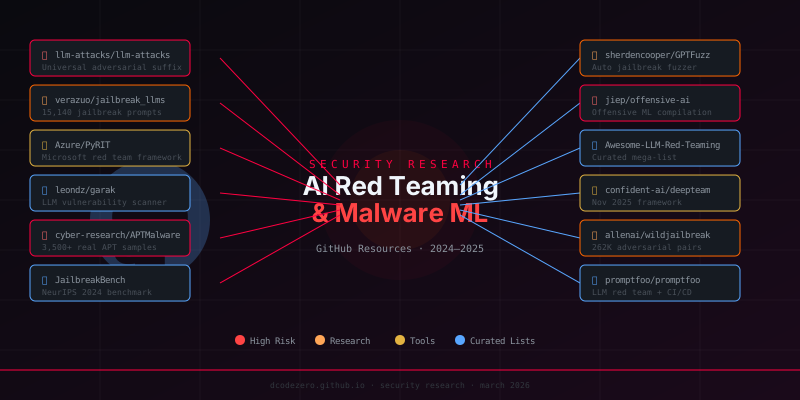
AI red teaming is mandatory now. You cannot defend against AI-augmented attacks without red-teaming your own AI systems AND using AI in your red team operations to find gaps before attackers do. Google’s dedicated AI Red Team, Pentera’s adversarial AI agent, RunSybil’s $40M bet on autonomous offensive security — the industry is screaming this at you.
Assume breach, always. The “prevent everything” model is dead. Your incident response plan needs to assume that a sufficiently motivated, AI-equipped adversary will get initial access. The question is whether you can detect lateral movement and exfil before the damage is done.
Hunt for C2 traffic, don’t wait for alerts. Proactive threat hunting for beacon patterns, unusual DNS queries, HTTPS to unknown CDNs, and cloud API anomalies catches what automated tools miss. A dedicated threat hunt team running Sliver/Havoc/Mythic indicators in your telemetry is worth more than three additional EDR licenses.
The Uncomfortable Truth
The cybersecurity industry has a revenue-aligned incentive to sell you products rather than tell you the hard truth: most enterprise security stacks are woefully behind the current threat landscape. Your vendor’s AI feature is a marketing checkbox. The attacker’s AI is actively improving every single campaign.
The gap between offensive capability and defensive capability has never been wider. AI-C2 frameworks are not a future threat — they are this quarter’s threat. Organizations that treat this as “next year’s problem” are this year’s breach victims.
Practical Takeaways
- Audit your C2 detection rules — Are they catching Sliver, Havoc, and Mythic, or just Cobalt Strike Beacon from 2021?
- Run a cloud API abuse exercise — Can your SOC detect a Teams or Slack webhook being used as a C2 channel?
- Enforce FIDO2 everywhere tier-0 touches — The identity layer is the last one that reliably holds.
- Stand up a threat hunt program — Even two dedicated hunters reviewing telemetry weekly will find what automated tools miss.
- Start AI red teaming your own AI stack — LLM wrappers, AI coding assistants, agentic workflows — these are all new attack surfaces with zero mature defensive tooling.
- Map your LOTL exposure — Which legitimate tools (PSExec, WMI, Python, PowerShell) could an attacker abuse in your environment? Instrument them all.
The attackers didn’t wait for the market to mature. Neither should you.
DcodeZero covers offensive security, red team tradecraft, and threat intelligence. If this post made you uncomfortable, good — go fix something.